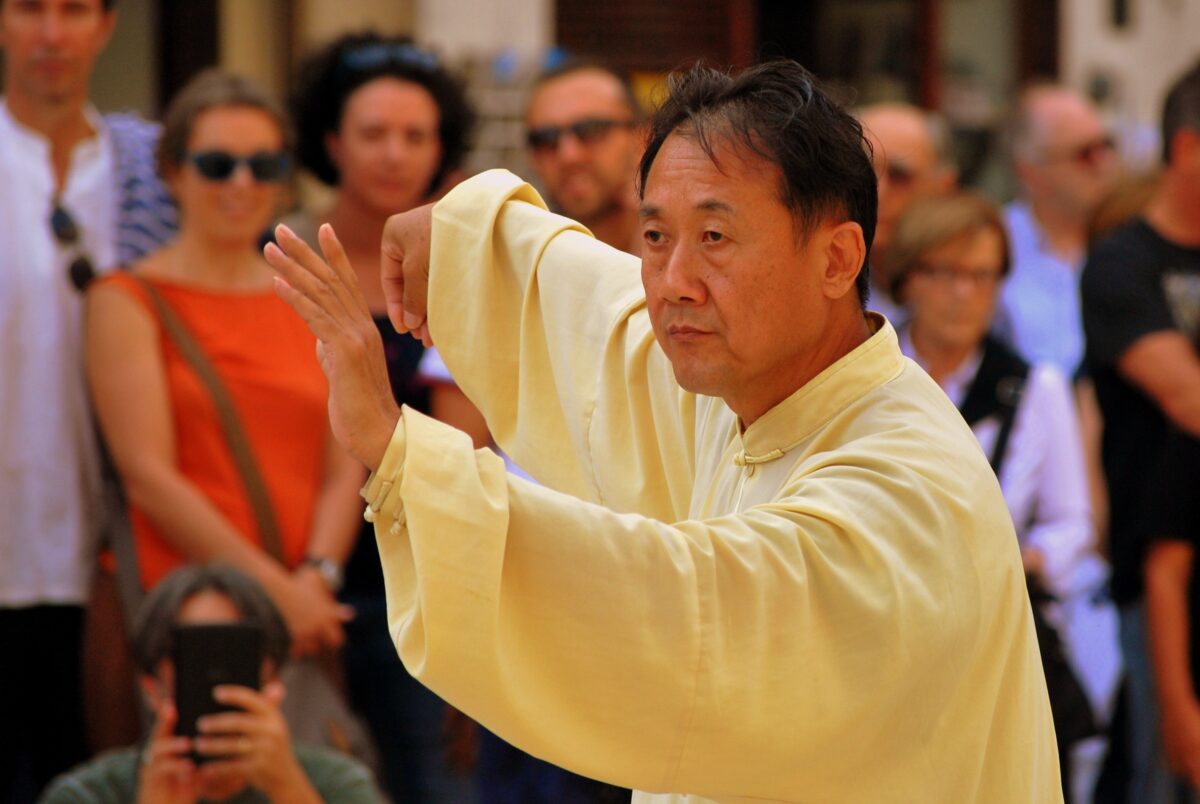
Tai Chi: Releasing Creativity

Tai Chi is often described as “meditation in motion”.  I have previously written about the benefits of Tai Chi for physical health, energy and psychological well-being.  I subsequently developed a mnemonic (F.R.A.I.C.H.E.) for capturing the benefits of Tai Chi in terms of improvements in physical and mental aspects that are beneficial for  playing social tennis:

  • F – flexibility
  • R – reflexes
  • A – awareness
  • I – integration
  • – coordination
  • – heart health
  •  – energy .

More recently I have had to play pickleball instead of tennis because of personal, physical limitations such as osteoarthritis in my hands and wrist, osteoporosis, exercise asthma and multi-level disc degeneration.  Tai Chi can assist in reducing the impact of some of these limitations.  However, I have also found that Tai Chi practice has helped me release my creativity when playing pickleball.

Releasing creativity.

Overcoming the pressure of expectations can have a freeing effect in terms of creative pickleball play.  This is partly why I have chosen to play “intermediate recreational” pickleball games rather than “intermediate competitive” – the former places emphasis on fun and social interaction, while the latter is focused on winning.

Tai Chi practice adds another range of benefits by releasing creativity during pickleball games.  Based on my personal experience, I have identified these benefits as follows:

  • Overcoming a blind spot – in the past, I have had a blind spot in relation to using a  topspin backhand in tennis.  I had developed the false self-belief that this stroke was beyond me.  This belief was founded in the fact that my early tennis training involved the use of a  one-handed backhand that utilised either a flat shot or a slice, not a topspin.  I sustained this belief when I started playing pickleball.  However, a recent game experience proved that this was indeed a “blind spot” – that there was no basis for sustaining this belief when playing pickleball. This blind spot had been restricting my creativity during intermediate recreational games (which typically involve competent pickleball players who use a range of spins in serving, driving and volleying).
  • Activating body memory – especially procedural memory.  This form of body memory relates to “sensorimotor and kinesthetic faculties”.  Thomas Fuchs explains that “well-practiced patterns of movement and perception become embodied as skills or capacities” that we can use in everyday life such as bicycle riding, keyboard use and tennis strokes.  We can experience the impact of body memory on the procedural level when we sit down unconsciously on a car seat when someone else has lowered the seat.  We tend to feel a sudden drop and the discomfort of landing heavily in the seat (because our body expects the seat to be higher).  A similar experience occurs when trying to place knives in a drawer after someone has changed the order of the cutlery trays – we keep trying unconsciously to place the knives where they were originally.   The change in order can even create a sense of cognitive dissonance for us.   I found recently that despite my “blind spot” re the topspin backhand shot, I spontaneously executed such a shot during a game of pickleball – my body remembered how I had used this shot extensively when playing table tennis.   The Tai Chi practice enabled me to bypass my self-imposed limitations of the related “blindspot” and enabled me to activate my procedural memory in relation to this shot. 
  • Heightening instinctive physical responses – I have found when I regularly practise Tai Chi that my ability to access instinctive responses is heightened.  For example, when playing tennis I have executed a backhand, half-volley lob and a backhand half-volley drop shot – neither of which I have been taught or practised.  The same has happened when I have played pickleball, e.g. a half-volley drive off an opponent’s smash.   What Tai Chi enables us to do is not only to access procedural memory but also to bypass the “self-critic” that tells us that we can’t do something.  Tai Chi frees the body to respond instinctively to what it confronts when playing a sport. 
  • Accessing unconscious competence – Tai Chi has helped me to more readily access unconscious competence (mastery of a skill prior to playing pickleball).  After completing a Tai Chi practice session, I find that I can seamlessly adapt skills acquired in other sports to the challenge of playing a pickleball game, e.g. I can readily use six different spins in pickleball that I have developed through playing tennis, squash and table tennis.  The six spins are a forehand topspin, a slice (forehand and backhand), backspin (forehand and backhand), underspin (forehand and backhand) and spins that I have labelled “outswinger” and “inswinger”.  Also, I find that I can tap into acquired skills such as “anticipation” (reading an opponent’s shot before they actually play the shot by acutely observing body movement).  The power of concentration and “being-in-the-now” are acquired skills that are enhanced through Tai Chi and readily accessed by me during a game of pickleball.

Reflection

While Tai Chi develops strength and flexibility, one of its key benefits is the cultivation of stillness – leading to calmness, clarity, vitality and joy.  Creativity lies in stillness – the dynamism of silence and internal spaciousness.  In stillness, we are in touch with the present moment – not disturbed by thoughts of the future or the past.  We can readily dismiss negative self-stories and open our minds to creative possibilities. 

Tai Chi is only one form of mindfulness practice that can be cultivated in concert with other related practices such as mindful walking, meditation, and reflection.  As we grow in mindfulness, we can better access our positive instinctive responses, adapt our unconscious competencies, cultivate calmness and clarity and strengthen our capacity to concentrate and focus.

_______________________________________

Image by Gianni Crestani from Pixabay

By Ron Passfield – Copyright (Creative Commons license, Attribution–Non Commercial–No Derivatives)

Disclosure: If you purchase a product through this site, I may earn a commission which will help to pay for the site, the associated Meetup group, and the resources to support the blog.

Proactive Acceptance and Personal Research of Chronic Illness

I was very recently diagnosed with osteoporosis – an addition to my multiple chronic illnesses.  This diagnosis comes on top of existing chronic medical conditions including multilevel degenerative disc disease, exercise asthma, skin cancers, arthritis in my middle finger and MCAS (Mast Cell Activation Syndrome) with Histamine Intolerance (leading to multiple allergies/food sensitivities).  The existence of multiple chronic diseases prompted my medical practitioner to develop a Medicare-supplemented Chronic Disease Management Plan.

What I have learned from trying to manage my other chronic health conditions is that the way forward begins with acceptance of what is.  This is not a passive position but a proactive one entailing:

  • acknowledging the limitations imposed by your chronic illness
  • exploring the boundaries of the limitations (not accepting imagined restrictions or ones suggested by  a medical professional based on a limited perspective on your illness)
  • seeking expert and social support, e.g. the International Osteoporosis Foundation
  • redefining personal identity where that seems advisable
  • expressing gratitude for what you do have and can do
  • undertaking recommended testing
  • educating yourself about your medical condition – it’s precursors, progression and prognosis
  • researching healing modalities.

Why do personal research?

The reality is that medical practitioners, no matter how dedicated they are to your healing, are limited by time, training and discipline approach.   Very few are able to adopt a holistic perspective.  Given that chronic illness is typically complex, having a multisystem impact compounded by interdependency and interaction, a holistic perspective is often necessary to establish effective healing modalities.

Often medical practitioners, who are frequently time-poor because of the patient demand of their practice, adopt a symptomatic approach that just touches the surface of an illness and does not address the root causes.

I have experienced these limitations of medical practitioners and found that I had to supplement their perspective and approach with my own research and be an advocate for my own health improvement.  This personal research does not supplant the advice of a medical practitioner but supplements it, enabling you to ask, “What if…?”

My personal research in relation to osteoporosis

Following the personal research principle, I began to question why I was experiencing  osteoporosis when I had been exceeding the recommended intake of calcium for many years, mainly through Ostelin (Calcium and Vitamin D) and almond milk.  The question then arose as to how well my body was absorbing the calcium. 

In following this line of questioning, I learnt the following:

  • MCAS negatively impacts bone strength.  Dr. Lawrence B. Afrin (2013), international expert in MCAS, reports on research that shows that “premature osteopenia/osteoporosis is frequently found in mast cell disease patients”.  More recent research by David Harris (2024) shows that MCAS has a “direct role in bone metabolism” through the chemicals, such as histamine, released in the inflammatory response of MCAS.  He states that “this overactivation can lead to an imbalance in bone remodeling, favoring bone loss and increasing the risk of osteoporosis”.  So the focus on repair should include reducing histamine release through food control and anti-histamine medication/supplements.
  • My medical practitioner has given me a referral to an exercise physiologist to develop a weights exercise program which research shows helps to develop bone density and strength.  However, while this is important to undertake, it still addresses the symptom (loss of bone density), not the cause (potentially MCAS acting negatively on bone density).  To their credit, my medical practitioner had organised a bone density scan to identify the root cause of my degenerative disc disease and loss of height.  The scan established the existence of osteoporosis.
  • Exercise is an important part of the healing process for osteoporosis.  So my transition from playing tennis to playing pickleball, necessitated by arthritis of the middle finger on my right hand, is an important means to maintain an exercise regime and one that is less exacting but still providing weight-bearing activity essential for developing bone density and strength. There is also research that shows that people with osteoporosis should “avoid exercises with extreme spine curving forward, such as toe touches and sit-ups”.
  • I have previously written about the multiple benefits of Tai Chi and how it can improve your tennis game, as well as that of other racquet sports such as pickleball.  Tai Chi has been shown to improve bone health, being a gentle, weight bearing exercise.  This works in two major ways, (1) improving bone density and (2) improving balance and coordination (to prevent falls and related broken bones).  There are resources readily available to help people manage osteoporosis through Tai Chi such as Tai Chi for Osteoporosis (DVD by Dr. Paul Lam) and Tai Chi for Older People.

Further revelations from my personal research and experience

As I continued to research my chronic medical conditions, I discovered the following things that can impact my health:

Exercise anaphylaxis

Skin prick testing revealed that I have wheat allergy (among many other food sensitivities).  However, no medical practitioner mentioned to me that this could lead to what is known as “exercise anaphylaxis”.  Apparently, according to the Mayo Clinic, if you have a wheat allergy and you exercise “within a few hours after eating wheat” you can experience exercise-induced anaphylaxis

A holistic approach to MCAS incorporating nervous system regulation

Most practitioners who accept the existence of MCAS adopt a biomedical model which focuses solely on the body and the use of medications and supplements as the only healing modality.  Beth O’Hara, creator of Mast Cell 360, determined through her research and extensive work with patients that this approach adopted by most medical practitioners failed to address the nervous system, a key component of MCAS disease. Beth stated that righting the nervous system represented 50% of the necessary healing modality.  She was able to demonstrate through actual results that a healing modality for MCAS must include rewiring of three interrelated systems:

  • Parasympathetic re-balancing
  • Vagal nerve signalling
  • Limbic system re-regulation

To this end, Beth designed a masterclass titled Mast Cell Nervous System Reboot.  I have purchased this course and have been working my way through the science explaining the nature of MCAS and the underpinnings of Beth’s healing protocol. I am looking forward to undertaking the practices she incorporates in the course to calm the nervous system.   Her Mast Cell 360 website has multiple resources, including health coaches, for people experiencing MCAS and histamine intolerance.

Allergic arthritis

One of the things I discovered independently was the existence of allergic arthritis.  I had been wondering why the joint in my right middle finger was swollen whenever I experienced other allergic reactions.  Research has shown that allergies /food sensitivities, creating an inflammatory response, can aggravate existing arthritis and cause osteoarthritis in other parts of the body.

Low histamine foods – apples

Apples have been identified as a low histamine food.  I have found that I can readily tolerate Pink Lady apples without an allergic response.  However, I have also found that Red Delicious apples cause a serious reflux reaction, leading to a sensation of choking. 

High histamine foods – avocados

Avocados are identified as a high histamine food and can impact people who have a histamine intolerance.  However, research shows that avocados that are firm and not too ripe are lower in histamine than those that are soft and over-ripe.   This revelation was important for me as avocados have multiple health benefits and are a key part of my diet and are necessary to help me maintain my weight (which is a challenge given my restricted diet because of allergies/food sensitivities).


Reflection

The winter of my osteoporosis is yet to come as it is early days.  However proactive acceptance and personal research can enable me to maintain a summer perspective in relation to my chronic illnesses.  My research has highlighted things that I need to avoid, opened up new lines of inquiry, highlighted potential healing approaches and strengthened my ability to be an advocate for my own health with medical practitioners.

The more we grow in mindfulness through Tai Chi and other mindfulness practices such as mindful eating and mindful walking, the better we will be able to develop proactive acceptance, engage in personal research and find creative solutions to our chronic illness.

____________________________________

This post is provided for information purposes only and is not intended to replace personal medical advice provided by a trained medical practitioner.  Please seek advice from a qualified professional before deciding on treatments for yourself or other members of your family.  This article reflects my personal patient experience – MCAS and related diseases affect each individual differently.  I frequently share my research findings with my medical practitioner and this informs my treatment.

_______________________________________

Image by Yana Vakulina from Pixabay

By Ron Passfield- Copyright (Creative Commons license, Attribution-Non-Commercial -No Derivatives.

Disclosure: If you purchase a product through this site, I may earn a commission which will help to pay for the site, the associated Meetup group and the resources to support the blog.