Creativity Lies in Stillness and Silence

In 2015, GOMA (Gallery of Modern Art, Queensland) displayed 200 visual works of David Lynch including lithographs, photos, paintings, video art and photo collages.   David epitomises creativity – he is an American  filmmaker, artist, actor, musician and photographer and is considered by The Guardian to be “the most important Director of this era”.

The creative power of silence

In an interview on ABC Radio National in March 2015, David spoke about creative control and in the course of his interview, he stated that “the silence within has infinite dynamism”.   In his view, creative ideas come from within.   You start with an intention to develop an idea and then, if you are patient and focused, you suddenly see it and feel it as it reaches full consciousness.  He discusses open awareness (for instance, focusing attention on the beauty of a cherry tree) that stimulates wonder and the incessant desire to understand your world.

Jane Dawson in an article on reflection and creativity, contends that creative expression is thwarted by the busyness of life, especially in educational institutions.  She argues for the need for  “space for silence” to cultivate and pursue creativity and suggests that meditation provides that space.

The creative power of stillness

Jon Kabat-Zinn, in his 2011 interview with Krista Tippett, maintains that “spaciousness is already in the mind”.  The way to access this spaciousness that is the fountain of creativity is to develop intimacy with it – to be open to its power through the stillness of meditation.

Jon argues that one of the real barriers to developing creativity is our lack of training in the “deep interior capacities” of attention and awareness.  He argues that all our training is focused on thinking, so that we cut ourselves off from imagination and creativity by focusing on only one aspect of the mind’s capacities.   Whereas the real gateway to creativity is “the stillness of awareness of not knowing” – of being aware of what we do not know and what we do not understand.  Creativity is not achieved by being contented with the knowledge that we already hold.

As we grow in mindfulness through meditation and openness to our life and our world, we can cultivate the power of silence and stillness to access our innate imagination and creativity.

By Ron Passfield – Copyright (Creative Commons license, Attribution–Non Commercial–No Derivatives)

Image source: courtesy of jplenio on Pixabay

Disclosure: If you purchase a product through this site, I may earn a commission which will help to pay for the site, the associated Meetup group and the resources to support the blog.
Levels of Meditation

Noah Levine, discussed different levels of meditation during his presentation for the Mindfulness & Meditation Summit.  His topic was, Breaking the Addiction to Our Minds.

Noah identified three levels of meditation – (1) foundational – focus on breathing and grounding in the body, (2) second level – awareness of pain/suffering/attachment, (3) third level – overcoming the addiction to our minds.

He led listeners through a 10-minute meditation practice that was focused on the foundational level – mindful breathing.   This was an excellent meditation with skilful guidance.

Noah made the point that while there is no ideal amount of time for a meditation practice, starting somewhere in terms of time allocation is really important. He suggested that twenty minutes could be a starting point to realise some of the reinforcing benefits of meditation.  However, his strong recommendation is to aim for 45 minutes as a goal to attain because, in his experience, significant shifts/movements can occur in the last 10 minutes of this extended meditation period.

He cautions against expecting quick results and major shifts in the early stages:

Mindfulness is a gradual, systematic training that through our own efforts lead to these insights [about the impermanence of everything] and transformative wisdom [that recognises our addiction to our minds].

Noah points out too that addiction to our minds is different from other addictions such as addiction to smoking, drugs or food.  As he explained from his own experience, many addictions can be overcome through abstinence – but this is not true of addiction to the mind and thinking.  Like breathing, thinking occurs independent of us and is an essential part of our human existence.  The problem arises when we allow our mind, our thoughts, to control our lives without the highly developed skill of discernment.

A particular insight that Noah offered is that reflection – reviewing, evaluating, planning – is not mindfulness.  For me, as an action learning practitioner and teacher, reflection is integral to my daily way of life, whether it is concerning how I play tennis, conduct a workshop or engage another person in conversation.  Reflection is still an act of (critical) thinking, which – though necessary to life and professional practice – is not mindfulness.

I think a key learning from Noah’s presentation is that we grow in mindfulness gradually as we develop our meditation practice to the point where we are able to overcome addiction to our minds and the process of thinking.

By Ron Passfield – Copyright (Creative Commons license, Attribution–Non Commercial–No Derivatives)

Mindful Breathing – Being, not Thinking

Western society is strong on thinking and we have developed so many words to describe the act of thinking.  Here’s just a few:

  • analyze
  • summarize
  • categorize
  • synthesize
  • realize

Jon Kabat-Zinn suggests that we have become so engrossed in thinking all the time that we have lost the art of just being.  We have lost touch with the present moment with all its potential for creativity, calm and clarity. He strongly recommends developing the art of mindful breathing and offers a 3 minute meditation exercise based on conscious breathing:

One of the challenges of mindful breathing is to stop the distraction of thinking and to remain focused in a non-judgmental way – clearing our thoughts as they occur without judging ourselves for their occurrence.

Isabel Allende in her book, Maya’s Notebook, describes Maya talking to her host Manuel and, in the process, identifies the difficulty of staying focused on breathing – on being, not thinking:

I found him watching the sunset from the big front window, and I asked him what he was doing.

“Breathing.”

“I’m breathing too.  That is not what I was referring to.”

“Until you interrupted me, Maya, I was breathing, nothing more.  You should see how difficult it is to breathe without thinking.”   [Maya’s Notebook, p.69]

And therein lies the challenge of mindful breathing – not only do you have to fend off distractions caused by your own thoughts, but also the interruptions unwittingly caused by others who need to share their thoughts or want you to do so.  Thinking has become our substitute mode of being – we live in our minds not in the reality of everyday life and the present moment.

Psychologists point out that this disconnection from the present has resulted in much of the mental illness that is prevalent today – we suffer depression because we are living in the past or suffer anxiety because we are living in the future. Mental health and well-being reside in mindfulness and mindful breathing that are accessible to us at any moment.

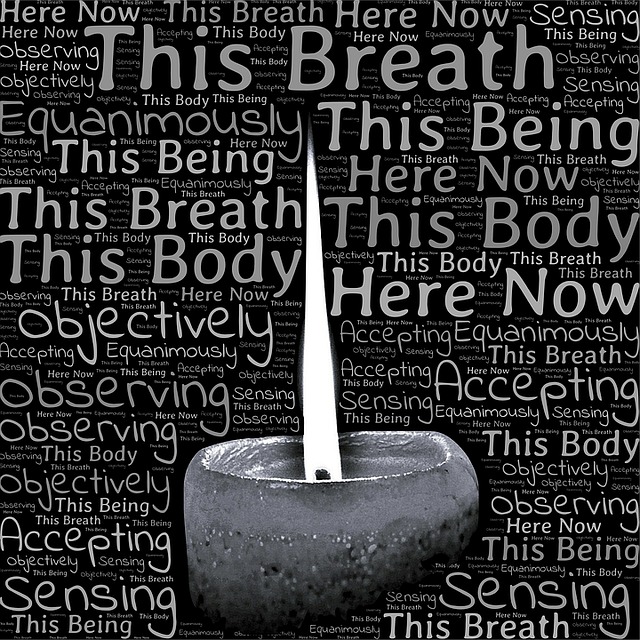
Image Source: Courtesy of Pixabay.com


Living in the Present – Not the Future


Maria, in Paulo Coelho’s book, Eleven Minutes, records in her diary:

I spend all day …longing for work to begin, and, when I’m working, longing to get back to the boarding house.  In other words, I’m living the future not the present. (p.34, emphasis added)

Recent neuroscience research shows that we spend more than 50% of our time either in the past or in the future – we spend so little time in the present.

The downside of spending so much time “living the future” is that we can develop anxiety because we are constantly concerned about future events that may never happen.  We are also missing the opportunity to fully experience the present – to enjoy the beauty, relationships and positive experiences that surround us.

We also miss the opportunity to appreciate what we do have and be grateful for the many things that make our life enjoyable.

Living in the future can be precipitated by envy – we “want to have what they have got” and so we look to the future in the hope that we too will be like them.

One way to check whether you are living the future is to monitor your words:

  • I wish it was Friday
  • I can’t wait for the weekend
  • Summer holidays can’t come soon enough

If we find ourselves constantly expressing desire for the future rather than experiencing and enjoying the present, then we can stop talking this way – we have the power to shape our reality by choosing our words consciously.

The present moment is the only true reality.  If we miss it, we miss so much that life has to offer and potentially harm ourselves and our wellbeing.

Image Source: Copyright R. Passfield