Reframing Assumptions

Our assumptions play a major role in our lives.  They shape our perceptions, influence our emotions and affect our responses to people and events.

On one occasion, I was talking to a colleague who had been using a collaborative approach to undertake local economic development in a regional area.  He was telling me about a community consultation meeting that he had conducted on the Sunday before.  As he spoke, he became progressively more upset, agitated and frustrated.

When I asked him why he was so upset, he told me that the Mayor of the town had turned up to the meeting.  He then proceeded to share his negative perception about his attendance – “Why was the Mayor at the meeting?”, “Why was he getting in the road of our project?”, “What was he hoping to gain by being there?”

When I asked about the Mayor’s behaviour during his participation in the meeting, it turned out that he had participated constructively like everyone else present.  My colleague’s negative assumptions about the Mayor’s motivation and intentions were influencing his perception, his emotions and his response.

I suggested that he could actually think differently about the Mayor’s attendance – he could reframe his assumptions.  I said that I do not know of many Mayors that would spend an entire day on a Sunday, away from their family, to attend a meeting that was entirely optional. I suggested that the Mayor could have attended the meeting because he was genuinely interested in local economic development and community welfare.

After thinking this through, my colleague started to see the Mayor’s attendance as a positive thing – a sign of support rather than an attempt to sabotage his own efforts.  By challenging his assumptions, my colleague could reframe the event and the participation of the Mayor – he saw the person and the situation in a new light.

Our assumptions play out in every sphere of our lives – at work, at home, in the community – and operate at an unconscious level.  As we grow in mindfulness and inner awareness, we are more likely to become aware of our assumptions and the negative impact they can have on our perception, our emotions and our responses to people and events.

Image Source: Courtesy of Pixabay

Reflection and the Art of Solving Jigsaw Puzzles

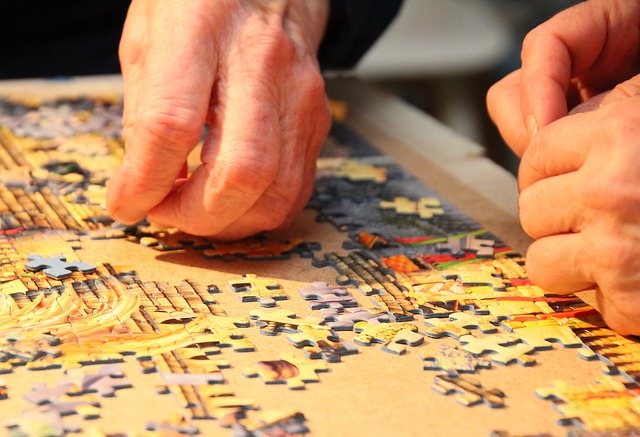
Our family has had a long-standing tradition of solving a 1,000 piece jigsaw puzzle whenever we go away on holidays for more than a week.

The collaborative endeavour of solving the jigsaw puzzle has a relaxing effect, builds relationships and facilitates conversation.

Recently, my wife and I went on a holiday and in line with our family tradition purchased a 1,000 word WASJIG? jigsaw puzzle. These puzzles are particularly difficult because the image on the box depicts the present scenario – the jigsaw puzzle itself reflects the same scenario at some future time.  So the image you are provided with is just a guide – and sometimes intentionally misleading.

When solving the jigsaw puzzle, it was particularly important to challenge your own assumptions – to change your assumptions about shape, colour or location of a puzzle piece (or sometimes, all three aspects).  Often when you got stuck, the way forward was to challenge one or more of your assumptions.  This challenge to assumptions was particularly aided by the reflections of the other person, e.g.”Could that piece go at the top, rather than the bottom”; “This looks like becoming a car, not a shop”; “There seems to be a crowd outside the train, have you thought of that to explain the missing pieces?; “Could those two connected pieces be placed vertically rather than horizontally?; “I think that we should sort the last 100 pieces by shape rather than by colour as we have them now.”

The reality is that we have limited perception – we often see what we want to see and often fail to see what is in front of us.  We also experience perceptual bias based on our own life experiences.  So it is important to reflect with others, to be open to perceptions and perspectives of other people, if we are going to move forward in whatever endeavour we are undertaking.

How often have you worked on a jigsaw puzzle and been unable to find a particular piece and someone walks past and says “this piece looks like it should fill the gap” (and they may have had no prior involvement in the puzzle solving process).  They are able to see the puzzle with fresh eyes and have no preconceived ideas or assumptions.

I was reflecting on our processes for solving this jigsaw puzzle and was reminded of the words of Reg Revans, the father of action learning, who suggested that really effective reflection requires challenging our own assumptions.  He also maintained that this challenge to our assumptions was achieved more often by reflecting with one or more others.  He suggests that when we reflect alone we can often reinforce our existing assumptions – when we reflect with others our assumptions can be open to the challenge of others.

The process of reflection has a strong relationship to mindfulness.  As we build our ability to reflect, we become more aware of the need to be mindful in the situation as an aid to reflection (e.g. “If only I had really noticed her reaction at the time, I could have done something about it!”).  It is difficult to reflect on what you have said or done, if you lack awareness at the time.  In a similar way, when we become more mindful through mindfulness practices, we are better able to reflect-in-action, to reflect on our own words and actions while we are in the process of saying and doing.  So, in the final analysis, reflection and mindfulness are mutually reinforcing.

Image Source: Courtesy of Pixabay.com