Mindfulness and Response Ability

Mitra Manesh, in her podcast on Mindfulness and Responsibility, noted that the word “responsibility” has two components – “response” and “ability”.  Her discussion and guided meditation are aimed at expanding our ability to respond rather than react.

Mitra maintains that mindfulness meditation, encompassing mindful breathing and body scan, can increase our response options so that our life is not governed by reactivity.  To this end, she leads us in a guided meditation on two occasions throughout the podcast.

During her podcast, Mitra Manesh defines mindfulness as ‘kind awareness and acceptance of our present moment”.  She notes that mindfulness has three essential elements – kindness, acceptance and the present moment. As we grow in mindfulness, we increase our response choices so that we are not held captive to our habituated, reactive responses.

We can more readily accept the present moment with kindness towards ourselves and others.  Kindness towards ourselves requires self-compassion and self-acceptance.  Kindness towards others involves consideration and compassion – being thoughtful and empathetic towards others and their needs.

Reactivity

Typically, in a wide range of situations, we react without thinking or being aware of the consequences of our words or actions for ourselves or others.  If someone “steels” our parking space during busy Christmas shopping, we may have some choice words to say and/or gestures to make.  If someone’s behaviour sets off a trigger for us, we will often react in an inappropriate way, usually with a response whose intensity does not match the seemingly, insignificant word or action that triggered the response – we are in a heightened reactive mode.

Reactivity taps into habituated behaviour that we have developed over time in response to various stimuli in our lives – stimuli such as disturbing situations, annoying  people or frustrated expectations.

Mindfulness and response ability

Mindfulness enables us to identify the negative triggers, isolate our reactive response, name our feelings and provide us with a choice space between stimulus and response.  We are able to expand our choice of responses and maintain calmness and clarity despite the disturbing nature of the situation.

Mindfulness helps us to show up differently in our relationships.  Instead of reacting to conflict with our life partner or colleague by our habit of withdrawal, sullenness or hurtful words, we can have the presence of mind to avoid inflaming the situation and, instead, show consideration and kindness.  Habituated reactivity fractures relationships, mindful responsiveness enriches them.

Our response ability develops with meditation practice because it helps us to grow in self-awareness and self-management.   Mindfulness practice expands our response choices as we “walk the streets of life”.

Note: Mitra Manesh’s podcast is provided as one of the weekly mindfulness podcasts provided by the Mindfulness Awareness Research Center (MARC) at UCLA.

By Ron Passfield – Copyright (Creative Commons license, Attribution–Non Commercial–No Derivatives)

Image source: courtesy of Curriculum_Photografia on Pixabay

Disclosure: If you purchase a product through this site, I may earn a commission which will help to pay for the site, the associated Meetup group and the resources to support the blog.

Engaging With and Accepting Death

Annie Robinson, in her article, How Mindfulness Can Ease the Fear of Death and Dying, asserts that there is a strong movement in the West to reengage with death, encourage open conversations about death, and to pursue choices in dying that respect the values and vision of the dying person.  This is also the theme of Lucy Kalanithi’s TED talk and Paul Kalanithi’s book,  When Breath Becomes Air, which he wrote while suffering from terminal cancer.

There are a number of characteristics of this movement and approach which involve dying mindfully:

Acceptance of death

Acceptance involves not only acknowledging the onset of death but all the feelings and thoughts that go with it.  This includes denial, sadness, suffering, anger, fear, grief and sense of loss associated with declining mental and physical capacity as well as the ultimate separation from loved ones.  It also includes accepting the loss of our old identity and an envisioned future and progressively forging a new identity and vision of dying.  Mindful acceptance does not remove the suffering but can reduce the pain and fear of death.

Being attuned to sensory experience

This involves paying attention to our senses – touch, taste, sight, hearing and smell- and experiencing the sensations such as a beautiful scene or sweet-smelling flower to a heightened degree.  It involves resting in these sensations while we can still experience them.  Some of these sensations will be intensified as we focus on them with our waning energy.  Annie suggests that being attuned to our sensory experience can develop joy and mindfulness.  Jon Kabat-Zinn, author of Coming to Our Senses, has demonstrated that focused attention on our senses can alleviate pain and help us to rewrite the narrative in our heads (including the narrative of fear and depression).

Finding balance through openness to love

Remaining open to love and caring of a partner, parents, children and relatives enables the dying person to find some level of balance as they alternate between pain and joy.  This requires vulnerability as their faculties decline and dependence increases; it also means that bitterness over loss on every dimension is not permitted to gain a stranglehold on emotions.  In his book, Paul Kalanithi was able to talk about marriage difficulties arising from his extreme workload as a neurosurgeon resident, working from 6am to late at night, 7 days a week.   His wife, Lucy, in the Epilogue to Paul’s book acknowledged that the cancer diagnosis enabled them to reinvigorate and deepen their love for each other and, in the face of  Paul’s dying, “to be vulnerable, kind, generous, grateful”.

Lucy wrote about the balance that emerged through their complete acceptance and trust in each other:

Although these last few years have been wrenching and difficult – sometimes almost impossible – they have also been the most beautiful and profound of my life, requiring the daily act of holding life and death, joy and pain in balance and exploring new depths of gratitude and love (p.219)

Lucy acknowledged that as you grow in mindfulness, you can find joy amidst the pain and grief, meaning when all seems lost and a profound gratitude that engenders fortitude and courage.

By Ron Passfield – Copyright (Creative Commons license, Attribution–Non Commercial–No Derivatives)

Image source: courtesy of realworkhard on Pixabay

Disclosure: If you purchase a product through this site, I may earn a commission which will help to pay for the site, the associated Meetup group and the resources to support the blog.

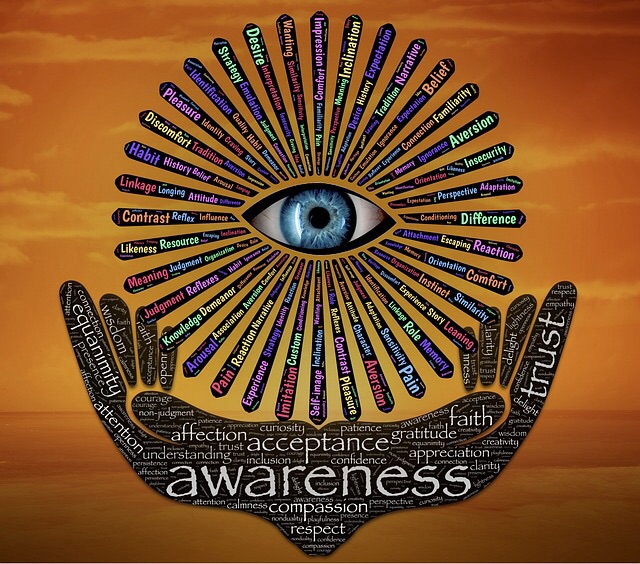
From Outer Landscape to Inner Landscape: The Growth of Awareness

In my previous post, I discussed mountains and rivers as a source of meditation and their predominance in Chinese landscape art. I also focused on the Shan shui tradition of landscape painting where the artists expressed their thoughts and emotions about a physical landscape in their painting.  In this way, they revealed something of their inner landscape.

Jon Kabat-Zinn, in his book Coming to Our Senses, describes each of the traditional five senses in terms of a landscape, e.g tastescape and touchscape.  After discussing each of the five senses, he introduces “mindscape” and describes its role as follows:

…ultimately it all comes down to what we call, by extension, mindscape.  Without the discerning capacity  of our minds, there would be no knowing of any landscape, inner or outer.  When we become aware, when we rest in the knowing, we are resting in the deep essence of mindscape, the vast empty spaciousness that is awareness itself.  (p. 234, emphases added)

He maintains that as we grow in mindfulness, we can gradually gain access to mindscape – that unadulterated awareness that is a deep insight into our inner landscape and our outer reality.

With this awareness comes the realisation that everything is passing – our sensations, thoughts and emotions.  They are here today and gone tomorrow.

Awareness increases our insight into our inner landscape and how we tend to cling to things that we want. It enables us to let go of our disappointments generated by the past and fears about the future.

Awareness leads to full acceptance of ourselves as we are – with our bodies and our quirks.  However, being able to access full awareness, mindscape, does not mean that we will not go backwards towards lacking acceptance or engaging in internal conflict.  As Kabat-Zinn points out “that is part of the human condition”.

He goes on to say, encouragingly:

But, there may very well be a gradual shift in the balance over time, from more inner conflict to more equanimity, from more anger to more compassion, from predominantly seeing only appearances to a deep apprehending of the actuality of things. Or there may be so at times  but not at other times. (p. 235)

As we grow in mindfulness, we begin to see things as they actually are – we become less likely to project onto people, things or events, our negative perceptions shaped by our own life experiences.

Accessing mindscape, opens us up to full awareness of our inner landscape so that we can realise our full, creative potentiality, develop deep insight and self-compassion as well as compassion for others. In this state, we can find true peace and tranquility as we live our life more fully.

By Ron Passfield – Copyright (Creative Commons license, Attribution–Non Commercial–No Derivatives)

Image source: courtesy of  johnhain on Pixabay