
Tapping into Our Positive Energy Force

In a recent presentation as part of the You Can Heal Your Life Summit, Rajshree Patel emphasised that our breath is our life force.   She elaborates on this idea extensively in her book, The Power of Vital Force: Fuel Your Energy, Purpose and Performance with Ancient Secrets of Breath and Meditation.  She maintains that many people achieve “success”, but their harmful emotional life and/or turbulent relationships drain their energy and ensure that they are not happy.  Rajshree argues that they have not learnt to master their inner landscape – their thoughts, emotions and feelings.  For her, breathing is the gateway to life’s balance, energy and happiness.

In an interview recorded in a Moonshots Podcast, Rajshree argued that true self-awareness arises through our vital life force, the breath.  She stated that meditation is “the ability to perceive what is going on in your inner world as it is”.  For her, conscious breathing initiates meditation and enables you to achieve a level of perception of your inner landscape that gives you access to your innate power, potential and energy. Meditation through conscious breathing precipitates calmness, clarity and tranquillity – realised through evenness of our breath.  Rajshree pointed out that there is a proven relationship between how we breathe and our thoughts and emotions.  For example, research has demonstrated that a specific pattern of breathing occurs when people are shown photos depicting different emotions such as anger and fear.  The breathing pattern changes with each different emotion displayed.

Rajshree offers three ways to access our breath and suggests that these are pathways to meditation appropriate to different situations.  The three patterns she identifies are deep breathing, deep calm breathing and reset breathing.

Deep breathing

Conscious breathing brings us into the present moment, away from anxiety and fear about the future and from anger and resentment about the past.  Deep breathing is a mindfulness practice that builds our capacity to be in the present moment and tap into our internal power and energy source at any time during the day.  We might adopt this practice before we start our working day, after conducting a workshop or before beginning a meeting.  Rajshree reminds us that the in-breath draws in energy and vitality while the out-breath releases toxins and pent-up feelings.

The process of deep breathing involves placing your hand on your abdomen and taking a deep breath in, pushing your abdomen out.  Rajshree explains that often we take a shallow breath, drawing our abdomen in and trying to fill our chest with our breath.  She maintains that it is really important in deep breathing to expand the abdomen because this enables you to release “emotional blockages” that are held within this part of the body.  The in-breath should be taken as long as possible with a slow, controlled out-breath.  Having your hand on your abdomen helps you to be conscious of expanding your abdomen, rather than contracting it – of releasing emotion, not trapping it within you.  Rajshree suggests that you take 10 deep breaths at least three times a day – as practice builds awareness and competence.

Deep calm breathing

This form of breathing is designed to clear difficult emotions that may arise after a day’s work where you experience deadlines, noise, interruptions, unrealistic expectations, information overload and the resultant stress and overwhelm.  In a sense, deep calm breathing is a form of “letting go”.  If we don’t do this then we can become locked in a pattern of negative thoughts and emotions that finds expression in traffic rage, conflict with our partner or failure to listen empathetically to our children.  Little annoyances can catalyse a disproportionate, angry response.

The process of deep calm breathing involves deep abdomen breathing once again but this time you take in a deep breath and when you think you can’t breathe in anymore, you draw in more breath and then release the breath after a brief holding of the breath.  Rajshree maintains that this form of breathing breaks the link between mind, body and stress – releasing difficult emotions before they find expression in negative patterns of behaviour towards others.  She suggests that this mindfulness practice should be employed at the end of each working day before you leave the office or when you finish your workday when working from home. Doing 10 deep calm breaths at the end of the working day prevents negative emotions from taking hold and enables you to achieve a relative level of calm to face the rest of your day.

Reset breathing

This mindfulness practice is called “reset breathing” because the idea is to change your breathing from the form of breathing you take on after an experience of considerable agitation, e.g. conflict with your spouse, partner, boss or colleague; difficulty in getting to work on time; a spiteful interaction with a stranger or any other activity that raises your ire or upsets you unduly.  If we let this agitation fester, it drains our energy and frustrates our positive intentions.   As Rajshree points out, “our quality of life is directly related to our minds” and if we waste energy reliving the past and being resentful about our interactions, we destroy our chance of being happy, vibrant and energetic.

The process of reset breathing involves firstly recapturing the experience that caused you agitation.  Rajshree suggests that you close your eyes and try to envisage as fully as possible what you experienced at the time – your thoughts, actions, emotions and bodily sensations, as well as your perceptions of other people and your immediate environment.  After you have fully captured the precipitating experience, you take in a deep breath through your mouth followed by a sudden exhale accompanied by sounding “hmmm”!  Rajshree maintains that the vibration caused by this explosive sound is felt effectively between the eyes and positively activates the pituitary gland. 

Reflection

Our breathing occurs unconsciously moment by moment all day, every day that we are alive.  It is readily accessible wherever we are.  Breath is our life force and constant source of energy.  Conscious breathing, in whatever form it takes, enables us to access this life force and release difficult emotions and toxins in our physical system.  Our mind-body connection is clearly manifested through our breathing patterns.  As we grow in mindfulness through mindful breathing practices, reflection and other forms of meditation, we can achieve a profound level of self-awareness and an enhanced level of self-regulation and tap into our life purpose and creative energy.  Conscious breathing provides release from negative emotions and positively impacts the human body’s “energy system”. 

____________________________________________

Image by enriquelopezgarre from Pixabay

By Ron Passfield – Copyright (Creative Commons license, Attribution–Non Commercial–No Derivatives)

Disclosure: If you purchase a product through this site, I may earn a commission which will help to pay for the site, the associated Meetup group and the resources to support the blog.


Self-Compassion in Times of Uncertainty and the Coronavirus

There are many people offering ways to manage anxiety and fear in these times of uncertainty brought on by the global Coronavirus.  Psychologist Rick Hanson, for example,  provides multiple online mindfulness resources including the Wise Brain Bulletin.  In the latest issue (Volume 14.2), Kristin Neff and Chris Germer offer 10 self-compassion practices for self-management during this time of the pandemic.  Self-compassion is about being compassionate towards ourselves despite our mistakes, deficiencies and perceived weaknesses.  It takes time and effort to build self-compassion, particularly if we are used to negative self-talk, berating ourselves for our mistakes or constantly comparing ourselves to others (and coming up short in our own estimation).

Elsewhere, Kristin provides a video explanation of the concept of self-compassion, discusses the three components of self-compassion and offers exercises on how to develop each of these.  She also offers a range of guided meditations and exercises on the website for the  Center for Mindful Self-Compassion.   Kristin and Chris are co-developers of the Mindful Self-Compassion (MSP) Program designed for those who want to explore more fully the richness of this mindfulness approach.  They are very well qualified to teach mindfulness and compassion (for ourselves and others).

Additional Approaches to developing self-compassion

There are multiple resources and exercises available to help you build self-compassion.  Some that are very accessible and easy to use are:

  • Compassionate body scan: a 20-minute progressive body scan that focuses attention on different parts of the body and treats each part of the body with kind awareness and tension release.  The guided body scan is offered in separate audio recordings by both Kristin and Chris.
  • Mood tracking: an essential element in building the self-awareness necessary for developing self-compassion and improved mental health.  There are many mood tracker apps that help you identify your triggers and enable you to gain control over your emotional responses.  Steve Scott provides a review of the 14 best mood tracker apps available today.  These apps provide a ready means of tracking stimuli and your responses in terms of moods/feelings.

Reflection

Self-compassion is the antidote to negative self-evaluation, just as gratitude and savouring what we have reduces competitive comparison and envy.  As we grow in mindfulness and self-compassion through meditation, mindfulness practices/exercises and reflection on the triggers that precipitate our strong emotional responses, we can progressively develop self-intimacy and the self-regulation necessary to identify our negative triggers and control our responses.

____________________________________________

Image by Stephen Cruickshank from Pixabay

By Ron Passfield – Copyright (Creative Commons license, Attribution–Non Commercial–No Derivatives)

Disclosure: If you purchase a product through this site, I may earn a commission which will help to pay for the site, the associated Meetup group and the resources to support the blog.

Developing Resilience for Uncertain and Challenging Times

Danielle LaPorte – blogger, author, entrepreneur, podcaster and inspirational speaker – was recently interviewed by Tami Simon on the topic, Resilience in Challenging Times.   When asked how she is coping in the current Coronavirus crisis, she explained that in the main she is “feeling resilient” but sometimes drops out from her centre and experiences intense feelings of pain and sorrow.  For her, resilience is “coming home” to your true centre and your life as it is.  Danielle reinforced the need to fully face our fear and anxiety, rather than deny the reality of what is happening for us.  She reminds us that acceptance – accepting what is – is core to mindfulness, mental health and happiness.

Scenario thinking as a way to manage the uncertainties of life and business

Danielle drew on her role as a “social visionary” to recommend using scenario thinking as a way to manage through the uncertainties that confront us on every dimension of our lives today.  For example, with the staff of her entrepreneurial business she explored potential scenarios as they move forward, including the “worst possible” scenario.  Facing up to the worst possible scenario and exploring how you could cope gives you a sense of control over fear and anxiety – you have faced up to the thoughts that generate your fears and anxiety and diffused them by identifying ways to cope (rather than letting them whirl around in your head and disorientate you by pulling you away from your centre).  Danielle indicated that she applied scenario thinking to her personal life as well, even facing up to the possibility of her own death through Coronavirus infection.

In line with her scenario thinking and her role as a social futurist, Danielle suggested that the Coronavirus will bring out the best and worst in people.  We have seen this already, on the one hand, in panic buying and profiteering by hoarding and selling scare resources at exorbitant prices; on the other hand, the growing prevalence of kindness, thoughtfulness, generous sharing and compassionate action.   Danielle drew on Barbara Marx Hubbard’s analogy of the “crisis of birth” to talk about the pain of establishing a new world order where there is increasing integration of the scientific, social, economic and spiritual capacities of the human race through a process of “conscious evolution”.

The growth of heart-centred leadership

Danielle maintained that the current crisis creates a situation where heart-centred leadership becomes the new norm.  Leaders and managers of people working remotely as a result of enforced physical isolation are confronted with the need to be empathetic to the adverse situations experienced by many of their staff – some with ill parents, school-aged children at home, inadequate space, lack of necessary technical resources or inexperience in operating within a working from home environment.  Heart-centred leadership requires the development of compassion, a perception of leadership as resonance and the capacity to build leadership agility.

Danielle herself demonstrated heart-centred leadership when she spoke of “bothness” – the capacity to not only see and face your own suffering but also to recognise that others are suffering too, often experiencing much worse conditions and life circumstances than you are.  For example, she explained that the experience of a short supply of a particular grocery item bears no comparison to someone else’s situation where they have no food or any likelihood of obtaining anything that is nourishing.  Danielle suggests that her own pain and suffering is connecting her with “someone else with more pain”.  In the mutual experience of crisis, lies the energy of connectedness.

Reflection

The current Coronavirus crisis precipitates the development of self-intimacy rather than self-denial, the promotion of compassionate action over self-absorption, the growth of heart-centred leadership over narcissistic leadership and the emergence of a greater sense of connectedness, rather than disconnection.   As we grow in mindfulness – deep awareness of our self and others – through mindfulness practices, reflection and scenario thinking, we can maintain a positive mindset and contribute, however painfully, to the growth of a new, integrated world order.

____________________________________________

Image by Leslin_Liu from Pixabay

By Ron Passfield – Copyright (Creative Commons license, Attribution–Non Commercial–No Derivatives)

Disclosure: If you purchase a product through this site, I may earn a commission which will help to pay for the site, the associated Meetup group and the resources to support the blog.
Working from Home and Staying Mentally Healthy

Many people have been thrust into the situation of working from home because of the Coronavirus and related Government restrictions on movement and contact.  As a result, numerous people are ill-prepared for the challenges and opportunities involved.  However, there is plenty of advice available through blog posts, videos and podcasts to help us acquire the necessary information to work effectively from home.  There are also specific suggestions for particular groups of people, e.g. teachers working from home and working from home with kids. Many of these sources of information stress the need to stay mentally healthy as well as look after your physical welfare.  Here are some strategies to achieve both effectiveness and sound mental health.

Strategies for working from home healthily for mind and body

The pattern you create needs to meet your personal preferences (e.g. a morning person vs. night person), your lifestyle, family situation and location.  Here are some suggestions that may help you to make choices that are relevant to your needs and those around you:

  • Negotiate arrangements – this entails reaching at least a tentative agreement at the outset with other affected parties such as your boss, you partner and your colleagues – having some clear understandings and groundrules at the outset can pave the way for a relatively smooth transition to working from home and avoiding unnecessary conflict at a time when everyone is feeling stressed.  If you have a partner living at home with you, it pays to negotiate arrangements about working space, quiet time, coffee buying or making and eating arrangements (e.g. getting your own breakfast and lunch but sharing dinner preparation and eating).  It is often the little things that can bring daily angst if they are not sorted out early.  If you have had an extended marriage or living together arrangement, groundrules get established unconsciously and it pays to explore how these might change with one or both of you working from home.
  • Establish a routine: this gives you a sense of agency, the feeling that some aspects of your life are under control when everything else is changing constantly and creating uncertainty and anxiety.  It is strongly suggested by many authors that you maintain your daily routine of getting ready for work (e.g. showering, getting dressed well, and beginning work at a set time).  I think some flexibility here can be healthy without jeopardising your ability to work effectively and not waste time.  You might, for example, wear more comfortable clothes, introduce a morning exercise routine (to take advantage of the time saved in not having to travel to work), occasionally sleep in when you feel tired from the extra stress created by the Coronavirus) and take time for conscious reflection (e.g. writing a journal about what you are experiencing and how you are responding). Sleep is particularly important at this time to enable your body and mind to recuperate from the stresses that you will be experiencing.
  • Develop an exercise program: physical exercise reduces stress and builds positive mental health.  It is wonderful to see so many people making the most of their additional time at home to walk, run or ride in the open (particularly along the bayside where I live).   Yoga and Tai Chi, offer physical, mental and emotional benefits in these times of stress and anxiety. Getting some fresh air is important – there can be a tendency with social isolation and safe distancing to become stuck in your home and not take in the benefits of time spent mindfully in nature.  Activity is a great antidote to anxiety and depression.
  • Don’t sweat the news: in times of uncertainty, there is a strong tendency to become obsessive about news reports (via newspapers, emails, social media or podcasts).  This not only dissipates your focus but also exacerbates difficult feelings of anxiety, depression and loneliness.  Obviously, some information is important to know (e.g. available relief packages for individuals or businesses and Government advice/directives/legislation relevant to the Coronavirus).  Experts in the area of mental health suggest that establishing a set time or times during the day for catching up on the news can be a useful way to proceed (do you really have to be the first to know?).   It also pays to take note of the positive news, e.g. the many random acts of kindness that are occurring everywhere in the world as people struggle to cope with the present crisis.
  • Stay connected: with your work colleagues and boss – establish a routine for checking-in (preferably daily) as well as strategies to effectively employ electronic communication for planning, sharing and product/service development.  There is a need here to maintain the balance between work and task – not oversharing social information but not being overly focused on work alone.  Some work-from-home groups institute a set time each week to share recipes, a virtual lunch experience or happy hour, a sing-along or coping strategies. 
  • Undertake special projects: there are often work-related, home-based projects that have been put off because of lack of time or prioritising.  These projects can improve your work-from-home situation and enhance your productivity.  They could involve, for instance, clearing up the clutter in your “office”, strengthening the security of your computer system, improving recycling in the home (including disposal of sensitive work information) or establishing a home-based coffee-making machine or a filtered water system such as the Zanzen Alkaline Water System.

Elizabeth Gilbert, author of Big Magic: Creative Living Beyond Fear, recently participated in a Ted Connects© interview and provided deep insight and very sound advice about dealing with the overwhelm of the current Coronavirus crisis.  She advices strongly against substituting the busyness of the workplace environment with a new form of busyness in the working from home environment.  Elizabeth argues that we spend so much time running away from ourselves, not fronting up to ourselves including our fear and anxiety.  She argues that the present situation of enforced or voluntary working from home creates a wonderful opportunity for developing self-awareness and self-regulation through meditation, mindfulness practices and reflection.  Often our greatest, unconscious fear is being-alone-with-our-self.  We seek distractions and fill up our time with multiple tasks only to find that we have no time to truly find ourselves. 

Reflection

The current working from home situation that many of us face has inherent challenges and opportunities compounded by the requirements around social distancing, safe distancing and avoidance of unnecessary travel (local and international).  Clarifying working arrangements, establishing a routine, developing an exercise program, avoiding obsessing over the news, staying connected and undertaking special projects that enhance a sense of control over your environment, are all important for a healthy mind and body. 

However, the real challenge and opportunity lies in developing self-awareness and self-management through meditation, mindfulness practices and reflection.  As we grow in mindfulness, we enhance our focus (at a time of intensified distraction), our resilience (at a time of extreme mental and emotional stress), our creativity (when we appear lost for personal and community solutions) and our compassion (when so many people worldwide are suffering and grieving).  In all of this turmoil and uncertainty, there lies the opportunity to truly find ourselves.

________________________________________

Image by Igor Ovsyannykov from Pixabay

By Ron Passfield – Copyright (Creative Commons license, Attribution–Non Commercial–No Derivatives)

Disclosure: If you purchase a product through this site, I may earn a commission which will help to pay for the site, the associated Meetup group and the resources to support the blog.

Managing Yourself in Times of Crisis

Susan David was recently interviewed as part the Ted Connects© series of talks.  Susan spoke on the topic, How to be Your Best Self in Times of Crisis.  She maintained that “life’s beauty is inseparable from it’s fragility” and provided a number of ways to manage yourself in times of crisis.  She emphasised the importance of facing our difficult emotions, naming our feelings, being curious about what our emotions are telling us, developing our sense of agency and finding ways to help other people.  Susan stressed that underpinning her approach is the concept of “emotional agility” – the core of which involves “radical acceptance” of our emotions and self-compassion.

The fragility of life

Susan reminds us that the Coronavirus highlights the fragility of life. This fragility, however, is part of our everyday life experience. We love someone then lose them, we enjoy good health then experience illness, we savour time with our children only to watch them grow up and leave home.  The problem for us is that our social narrative, the stories we tell ourselves as a society, is so focused on the importance of always achieving, being fit and happy and appearing to be always in control.  There is an inherent denial of the reality of death and the fragility of life – we have to appear to be strong and deny our difficult emotions.

Facing our difficult emotions

Susan stressed the importance of overcoming our habituated way of responding to difficult emotions.  We typically deny them, turn away from them and, yet, end up stuck in them or “marinating in it” as Rick Hanson, in his Being Well Podcast, describes the resultant state of self-absorption.  Susan maintains the critical importance of facing our emotions and owning them, not letting them own us.  This involves naming our feelings not in a broad way such as “I’m feeling stressed” but in what she calls a “granular” way or fine-grained identification of exactly what we are feeling, e.g. disappointment, resentment, anger, fear or anxiety.  It is only by truly facing and naming our difficult feelings that we can tame them, stop them from owning us.  Susan points out that this self-regulation is a key facet of mindfulness.

Being curious about our difficult emotions

This is a form of self-observation and self-exploration. It’s being curious about what our difficult emotions are telling us about ourselves and what we value.  Strong emotions are indicators of what is important to us but, at the time, perceived as lacking in our personal situation.  Loneliness, for example, is experienced as disconnection from others and tells us how much we value relationships and connection.  Social distancing and social isolation, as a result of the Coronavirus, have compounded our feelings of loneliness.  So, it’s important to move towards ways of re-connecting, if not face-to face, by phone and online communication. 

Developing our sense of agency

Susan argues that in these times when everything seems out of control, it is important to develop “pockets of control” to enable us to develop our sense of agency – our capacity to control some aspect of our life and our immediate environment.  These arenas of control can be minute things like deciding what three things you want to do today, developing a menu plan for the week, setting up a daily routine (especially when you are working at home with children present) or changing the way you normally do things to adapt to changing circumstances.  It may be that you decide to master the skill of online communication – developing new capacities as well as gaining control.  Some people look to regain control and appreciation over their own yard or garden.  My wife and I have recently bought a coffee-making machine so that we can better control our expenditure on coffee, increase our control over how our cappuccinos or Piccolos are made and limit our time and social exposure by avoiding having to go out and queue up for a take-way coffee.

Sense of agency can extend to appreciating what we have and savouring it.  The Coronavirus attacks our respiratory system, quite literally taking our breath away.  We can begin to really value our breathing through various forms of meditation which can ground us in our body in these times of uncertainty and anxiety.  As we learn to control our breathing through meditation, we can develop ways to calm ourselves in times of crisis and stress.  Our calmness is reflected in our breathing, as is our agitation. 

Helping others in need

Besides showing compassion towards ourselves (in owning and accepting our emotions and what they tell us about ourselves), it is important to move beyond self-absorption to thinking of others and undertaking compassionate action towards them.  This may mean a simple phone call to an elderly relative who is in lock-down in a retirement village or contacting someone you have not spoken to for a while.  Everyday we hear about people showing random acts of kindness and generosity towards others.

For example, our weekend newspaper reported about the wife of a doctor on the frontline of the fight against the Coronavirus.  He has decided to live apart from the family for six months to protect them from contracting the virus.  Despite her resultant loneliness, his wife is creating homemade meals for him and his fellow health workers and enlisting the support of neighbours, friends and anyone else to do likewise so that these frontline workers don’t have to rely on unhealthy take-aways to sustain them during their very long hours of courageously caring for others.  Susan challenges each of us with the question, “How can we help in little and big ways?” – how can we demonstrate being part of a community and being “values-connected”?

Reflection

In times like the present with the Coronavirus impacting every facet of our lives, we begin to wonder how we will all cope.  Susan expresses great optimism that the crisis will enable people to be their “best self” and daily we see evidence of this.  Susan points to the history of people handling crises with courage, wisdom, compassion and mutual kindness (witness the recent wildfires in Australia).  As we grow in mindfulness and learn to face our difficult emotions through meditation and reflection, we can understand better what our emotions are telling us, regain our sense of agency and begin to show compassionate action towards others in need.  Mindfulness helps us to be calm, resilient and hopeful.  

________________________________________

Image by ShonEjai from Pixabay

By Ron Passfield – Copyright (Creative Commons license, Attribution–Non Commercial–No Derivatives)

Disclosure: If you purchase a product through this site, I may earn a commission which will help to pay for the site, the associated Meetup group and the resources to support the blog.

Turning Fear into Resilience in the Time of the Coronavirus

Rick Hanson recently produced a Being Well Podcast focused on Fear in the Time of the Coronavirus.  He provided strategies to deal with fear (both rational and irrational) and to convert fear to resilience by drawing on our inner resources – determination, true grit, courage and creativity.  Rick is the author of Resilient: Find your inner Strength and provides numerous resources on his website to help us develop resilience, wisdom, happiness and mindful relationships.  

His emphasis is on building personal agency.  With the Coronavirus impacting every facet of our lives and reducing our sense of control over our home and work environment, we are experiencing a loss of our “sense of agency”.   We often try to redress this lack of a sense of agency by adopting ineffective ways to regain control over our environments, e.g. panic buying of water, toilet paper and sanitisers.  We can feel helpless and, in consequence, resort to ways of coping that result in misplaced and unproductive effort.

Anxiety can operate on a number of dimensions – e.g. unhelpful or useful anxiety.  At the extreme, we can be too anxious (disabled by our fear) which is unhelpful and harmful to our mental health, overall wellness and our relationships.  Useful anxiety, the mind’s warning system, can create a sense of urgency/intense focus and stimulate constructive action and a strong sense of agency which, in turn, cultivates resilience.  Alternatively, we can be consumed by our sense of helplessness and end up “marinating in it” – to the point where we experience depression and the associated inertia.

Turning fear into resilience

Rick suggest three processes you can adopt to move from helplessness to a sense of agency and personal resilience.  The basic steps involve:

  1. Being fully with your current experience – facing your difficult thoughts and emotions and the reality of the challenges both present and ahead.  This means naming your feelings (such as anxiety, pain, fear, frustration) and being with them, not denying them out of a need to appear totally in control.  It means not giving into your “shoulds” that come with your absolutes.  It is human and normal to be anxious and fearful when confronted with the reality of the Coronavirus.  The choice lies in deciding whether to maintain a sense of helplessness or to move towards a sense of agency and control.
  2. Release thoughts and emotions that are harmful – This includes letting go of obsessive thinking and the endless cycle of “what if” (catastrophising).  It means to treat our emotions as data informing us about a threat to our wellbeing.  We are more than our thoughts and emotions.  It means avoiding absorption with the latest media posts and news, when we cannot do anything about the reported information, or the situations involved.   The reporting is typically sensationalist, alarmist and distorted and is designed to induce fear and dependence.  Don’t sweat the news for your own personal welfare and mental health.
  3. Shift your attention to what would be beneficial for you and others you interact with or service – this means focusing on what you can do in the situation, given all the constraints that you are experiencing.  It means moving from inertness to being creative in the way you spend your time – finding things to focus on and do that are helpful to yourself, your family and those you interact with.  This could involve rethinking your workday, using online communication technology (such as Zoom) or reengineering your business (adopting take-away options, providing delivery services, or switching manufacturing to a much-needed resource in the current crisis, e.g. rum and gin distilleries producing bottles of sanitisers).  The oft-spoken saying – “necessity is the mother of invention” – is particularly true at this time.  The opportunity exists to use this time of social isolation, social distancing and business lockdown to develop new horizons and new skills.  Adopting activities that promote a positive mindset can be helpful here.

Tools to overcome unhelpful anxiety

Rick offered a range of suggestions that can enable you to overcome harmful anxiety and move to proactive action to do things that are beneficial for yourself and others.

  1. Use your breathing to calm your body – Rick suggests taking three breaths (exhalation longer than inhalation, giving a resting state of the body).  There are multiple ways you can use your breath to calm yourself and restore your equanimity, e.g. the somatic awareness approach recommended by Jill Satterfield or “breathing in time” suggested by Richard Wolf.
  2. Tune into your inner strength – revisit your determination, courage, and resilience to strengthen your inner reserves.  It can be helpful here to visualise success in your adaptive endeavours and/or reflect on past experiences where you have drawn on these personal strengths to overcome adversity or seemingly impossible challenges.
  3. Social support – appreciating the care and support that others show towards you, including your partner, family, friends and colleagues.   It also extends to caring for others and engaging others in the process of caring and providing social support to the less fortunate.
  4. Plan and act – appraise the situation and plan some action, however small, that will move you forward.  Rick reinforces the view that “action forces out anxiety”.  Positive action can change our mental state.
  5. When you feel okay, internalize the feeling – we tend to take it for granted that we will feel okay.  However, in times of stress and uncertainty, it is important to notice when you are feeling okay and internalise this feeling of coping well to strengthen it.  This positive self-feedback builds self-efficacy which means that you are building up your belief in your capacity to manage stressful situations.

Reflection

Fear can be disabling if we let it grow unabated.  It is natural to feel anxiety and fear when things are so uncertain, and everything associated with our normal life seems out of our control.  Fear, however, can be harmful unless we look at it fully in the face and understand what it is telling us about the situation we find ourselves in.  There are ways to calm our mind, emotions and our body if we choose.  There are also constructive things that we can do to manage our situation and our emotional response.  As we grow in mindfulness and self-awareness, we can turn fear into resilience by being able to regulate our response and draw on our inner strength to meet the challenges with determination, courage and creativity.

________________________________________

Image by JamesDeMers from Pixabay

By Ron Passfield – Copyright (Creative Commons license, Attribution–Non Commercial–No Derivatives)

Disclosure: If you purchase a product through this site, I may earn a commission which will help to pay for the site, the associated Meetup group and the resources to support the blog.
Mindfulness Meditation to Reduce Anxiety in Times of Uncertainty

In these times of increasing uncertainty, compounded by the global spread of the Coronavirus, the level of anxiety in individuals and the community at large can intensify (you only have to notice panic buying to witness anxiety contagion).  Anxiety impacts every facet of our lives – our relationships, problem solving, decision making and communication.  We can become abrupt with our significant others, quick to anger, argumentative, determined to prove we are right or hyper-critical of their words and action – all traits likely to damage close relationships which are built on mutual respect and appreciation.

Research also shows, for example, that 7% of people in Europe are frequently lonely.  The loneliness epidemic experienced in Australia, US and UK (where they have a cross-Government strategy to tackle the challenges involved) is exacerbated by the need to engage in social distancing, social isolation and, in increasing numbers, to work from home.  For people who are used to social contact and interaction at work, working from home can compound the loneliness problem. 

Added to the isolation from social work contacts is the banning of the normal places of social gatherings outside work such as restaurants, sporting events, concerts, university classes and professional conferences.  So, it is extremely difficult for people experiencing new levels and increased frequency of loneliness to find social support, other than electronically.  This puts pressure on people, young and old, to learn new ways of communicating (abbreviated social media messaging will not fill the void). Fortunately, new technologies for online communication such as Zoom have really helped to address the growing problem of physical isolation and its attendant problem of loneliness.

With more people out of work each day as businesses close under Government direction or because they are no longer viable in a social distancing environment, increasing numbers of people are experiencing economic anxiety and depression – they cannot see a way out of their current, seemingly intractable, financial problems. 

Before the Coronavirus, depression was already a major health issue in communities around the world.  Isolation and loss of employment – two very significant factors in precipitating or aggravating depression – are likely to accelerate the already exponential growth in depression in the community unless new ways are instituted by Governments, communities and entrepreneurs to redeploy people to arenas of employment experiencing growth in demand (such as healthcare support, farming and Coronavirus contact tracing) and individuals are able to find ways to address their mental health and overall wellbeing.

Mindfulness meditation – a way to address anxiety, loneliness and depression

Neuroscience research, such as that conducted by the Mindful Awareness Research Center (MARC), demonstrates the power of mindfulness and related meditation practices to eliminate anxiety, overcome loneliness and reduce depression.  A search on “meditation” in the search block of this blog will highlight many meditation practices for individuals to address these mental health challenges.  Some examples are:

MARC provides weekly meditation podcasts on a very wide range of topics.  These can be accessed either through their website or via the UCLA App providing “meditations for well-being”.   These meditations can be supplemented and reinforced by other mindfulness practices.

Reflection

The advent of the Coronavirus has compounded the problem of mental illness in communities around the world leading to growing anxiety, loneliness and depression.  People who previously did not experience these adverse mental health conditions are now succumbing to their widespread community encroachment.  Research has demonstrated that mindfulness meditation is an antidote to these mental health challenges and is a source of overall wellbeing. 

The personal challenge is to overcome our initial reservations and disbelief and to take advantage of the numerous sources of mindfulness meditation available to us.  At first, we are inclined to believe that the challenge to our mental health and welfare is too great and that meditation is too simple a solution.  However, beginning with some small meditation practice and maintaining it daily, can make a very significant positive impact on our mental and emotional state.

________________________________________

Image by Shahariar Lenin from Pixabay

By Ron Passfield – Copyright (Creative Commons license, Attribution–Non Commercial–No Derivatives)

Disclosure: If you purchase a product through this site, I may earn a commission which will help to pay for the site, the associated Meetup group and the resources to support the blog.

What Absolutes Are Holding You Back?

In a penetrating video presentation, Lance Allred asks the questions, “What is Your Polygamy?”  Polygamy in the context of his talk is a metaphor for the “absolutes” that we carry in our head from childhood (absolutes that have been reinforced by our own self-stories and by the projections of others).   Lance was raised in a polygamous Mormon community established by his grandfather. The community’s beliefs were very “black and white” – no room for grey.  Polygamy was practised because of the belief that the more wives you had, the closer you were to God. 

Lance’s absolutes included the following:

  • He had to prove himself to God and man because he was born defective as a legally deaf child
  • Mormonism is the one true faith and you can only get to Heaven if you are faithful to Mormon beliefs.

Lance escaped from the Mormon community at the age of 13 years, but he maintains that it is taking him a lifetime to escape his “absolutes”.  He did become the first legally deaf NBA player, but this became another trap – he became captured by the lights and accolades to the point were his sense of self-worth was dependent on the views of others.  He won the praise of others but began to lose his integrity.  He was so caught up with defining himself as an elite basketball player that when he was cut from the NBA team, he was severely depressed and entertained suicidal thoughts.

What are your absolutes?

Our absolutes are “culturally indoctrinated” and embedded in our everyday language – they live underneath the “shoulds”, the “musts” and the “have to’s” that we tell ourselves daily and use as excuses when confronted by personal challenges or the requests of others (either explicit or implicit requests).

Lance contends that knowing our “absolutes” is a journey into “self-intimacy” and overcoming them is a lifetime challenge of moving outside our “comfort zone”.   He argues persuasively that “we were not born to be caged within our comfort zones” – places of comfort created by our absolutes that we mistakenly view as giving us certainty in an increasingly uncertain and ambivalent world.

Our absolutes hold us back from becoming what we are capable of being.  We fear failure because with new endeavours we will need to move beyond what we know and are comfortable with.  We are concerned about what people will think of us if we don’t succeed in our endeavour, particularly if we put ourselves “out there”.  Lance, however, maintains that “you are bulletproof if your worth is not tied to an outcome” – in his view, by being authentic and true to yourself, you can overcome fear and rest in the knowledge that your worth can never be challenged or questioned.  Growth comes through discomfort, and failure contributes to growth because it precipitates deep learning about our self, our perceptions and our absolutes.

Reg Revans, the father of action learning maintained a similar argument, when he said:

If you try to do something significant about something imperative, you will come up against how you view yourself and how you define your role. 

Don’t let others determine what you are capable of

Lance stated that others can reinforce the cage of your comfort zone by projecting onto you their own absolutes and/or fears.  He tells the story of his first game as an NBA player that he came to play because someone was injured, and a replacement was not readily available.  The coach told him not to try to do too much, just settle for one or two goals and lots of defence.  He was effectively communicating his belief that Lance could not accomplish more because of his deafness disability.  Lance went on to score 30 goals in his first game as well as 10 rebounds.  His message as a result – “don’t define yourself by your disability and don’t let others determine what you are capable of”. 

Often people associate deafness with both physical and intellectual disability.  As Lance stated, the greatest challenge he had to face with his disability was not the disability itself, but others’ perceptions of who he was and what he was capable of.

Lance had been profoundly deaf since birth and had difficulty talking in a way that people could understand.  He spent thousands of hours in speech therapy and has become an accomplished public speaker and author.  I discussed his latest book, The New Alpha Male, in a previous post.

Reflection

In another video presentation, Lance contends that moving beyond our absolutes and associated fears takes perseverance and grit, traits that he maintains define leadership.  I can relate to the need for perseverance and grit in moving beyond peoples’ expectations of what you are capable of when you experience a disability. 

In 1974, a disc in my back collapsed resulting in my inability to walk or even stand without extreme sciatic pain.  I was told that I would never play tennis again. However, over 18 months, I undertook every form of therapy I could lay my hands on – chiropractic treatment, remedial massage therapy, hydrotherapy, acupuncture, light gym work, physiotherapy and osteopathy.  When using the exercise bike in a gym (I hate gyms!), I would envisage playing tennis again.  My osteopath, Dr. Graham Lyttle, got me back on deck and I having been playing social tennis weekly for the last 40 plus years.

I can also relate to Lance’s concept of “absolutes”.  As I used to play tennis fixtures at an “A” Grade level, I have carried in my head the absolute that I should not make a mistake at tennis.  Managing my expectations around this personal absolute, has been a constant challenge.  I can take to heart Lance’s exhortation that if your self-worth is not tied to an outcome, you can overcome your absolutes and become what you are capable of being.

As we grow in mindfulness, we can become aware of our absolutes and how they play out in our lives and develop the self-regulation and courage required to move outside our comfort zone and realise our full potential.  We can move beyond our procrastination and undertake our meaningful work.

_____________________________________

Image by John Hain from Pixabay

By Ron Passfield – Copyright (Creative Commons license, Attribution–Non Commercial–No Derivatives)

Disclosure: If you purchase a product through this site, I may earn a commission which will help to pay for the site, the associated Meetup group and the resources to support the blog.
Creating a Positive Future in a Climate-Changed World

Diana Winston recently provided a meditation podcast entitled, Envisioning a Positive Future in Our World.  The podcast was timely given the devastating fires across Australia in the months preceding and following the presentation and the ongoing challenge of gaining control over fires that continue to rage.  Diana’s guided meditation was a part of the weekly podcasts offered by MARC, UCLA.  Diana emphasised the need to draw on mindfulness for strength and resilience, to envisage a better future and to collaborate to achieve a better world.

The immeasurable impact of the Australian bushfires

The devastating impact of the Australian bushfires and wildfires was brought into sharp relief by the ABC Four Corners© program, Black Summer, aired on 3rd February 2020.  The program incorporated video footage from various areas and stages of the fires along with discussions by people who had survived the fires and lost their homes and/or family members, firefighters who described what it was like to be in thick of the fires, evacuation centre volunteers and elected officials living in areas impacted by the fires. 

Michael Pengilly, Mayor of Kangaroo Island in South Australia, summed up the extent of the physical devastation when he said:

So far this bushfire season, almost 12 million hectares have burned.  At least a billion native animals have died.  More than 3,000 homes have been destroyed and 33 people have lost their lives.

He pointed out that there were still bushfires creating havoc across Australia at the time of the TV program. 

Firefighters and people who had lost their homes and loved ones spoke of the trauma resulting from the fires, the fear of losing their lives, the 48 hours of blackness and the suffocating smoke that burned into your throat and lungs.  Aaron Salway, who lost his father and brother in the bushfires, spoke of the immeasurable impact on themselves and children who have experienced and survived the fires:

This fire I’ll never forget.  I don’t think my kids will ever forget it. It’s something that’s going to be scarred into my brain.  I don’t ever want to see it again.

When you see pictures of 60 metre high flames; raging fires driven by gale force winds (in excess of 80 kph); exhausted firefighters who have just heard that two of their colleagues had died in a fire truck rollover caused by a fallen tree; and flying embers moving at high speed horizontal to the ground, you understand that the emotional scars are deep and very real. 

Some of the lessons from the Australian bushfires

The fires brought to the fore the courage and resilience of individuals and communities when confronted with a crisis of this scale.  One such inspiring example was that of members of a Muslim Community who travelled for five hours to cook for exhausted firefighters in East Gippsland in Victoria and arranged five truckloads of donated goods to be delivered to people in fire-affected communities.

The firefighters (many of whom were volunteers) who risked their lives, and in some cases lost their lives, showed incredible commitment to helping others to deal with the frightening challenge of the fires raging out of control.  

One of the key lessons of the fires was what people could achieve when they pulled together, pooled their resources, supported each other emotionally and concerned themselves with the safety of others.  The questions and answers during the video episode highlighted some other key lessons:

  • The climate-changed world is a “new normal”
  • Unless people of different political persuasions can pull together and collaborate, there is no way that the situation can be redressed and the prognosis for the future be improved
  • Leaders at every level need to move beyond petty differences and demonstrate true leadership – marshalling committed followers to work towards creating a positive future
  • Australia must find ways to tap into the indigenous knowledge of landscape management – learning about and respecting the environment and related ecosystems.

Tackling climate change as individuals

In introducing her podcast, Diana highlighted an article by Emma Morris in the New York Times on January 10, 2020.  In the article, titled  How to Stop Freaking Out and Tackle Climate Change, Emma provides a sound five-point plan that individuals can pursue to move beyond paralysis by fear to constructive engagement:

  1. Ditch the shame
  2. Focus on the systems, not yourself
  3. Join an effective group
  4. Define your role
  5. Know what you are fighting for, not just what you are fighting against.

The last point demands moving beyond blaming to collaborative endeavour.  Emma’s plan shows what individuals can do to create a positive future for their children and grandchildren.

Diana draws on this discussion to incorporate a visioning exercise in her guided meditation.  After an introductory period focused on becoming grounded, Diana suggests that people engaging in the meditation begin to envision what a renewed environment would look like in terms of flourishing trees, clean air, running water, clear skies, happy children, healthy and diverse wildlife, numerous birds and butterflies – a very different picture to one of darkened skies, dense and suffocating smoke, children distressed about their future environment, blackened trees and flora and burned/dead animals (many of them in danger of extinction).  Diana maintains that the future is ours to create.

Reflection

As we grow in mindfulness through meditation and reflection, we can build our resilience; better appreciate our connectedness to others and our natural world; develop our motivation to collaborate and take compassionate action; overcome our biases and assumptions; and develop our personal role in helping to shape a positive future in our climate-changed world.

_____________________________________

Image by Johannes Plenio from Pixabay

By Ron Passfield – Copyright (Creative Commons license, Attribution–Non Commercial–No Derivatives)

Disclosure: If you purchase a product through this site, I may earn a commission which will help to pay for the site, the associated Meetup group and the resources to support the blog.

Deepening the Mind-Body Connection through Tai Chi

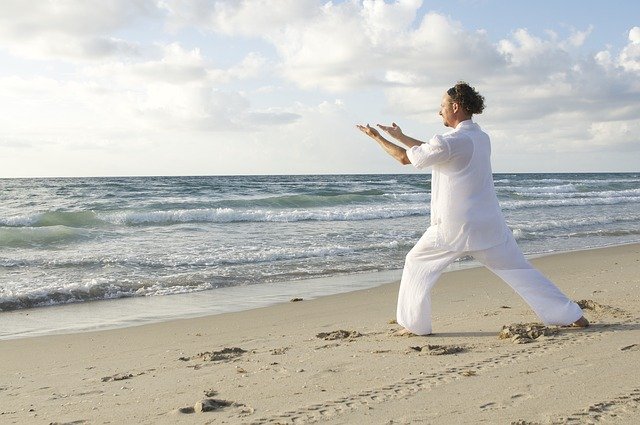
In the very early stages of this blog I discussed Tai Chi as a pathway to mindfulness.  I also highlighted the challenges I experienced in maintaining daily practice of Tai Chi along with meditation and writing this blog, when I still had a range of professional and personal  commitments to fulfill on a regular basis.   I concluded then that keeping the benefits of Tai Chi at the forefront of my mind, aligning my Tai Chi practice with the timing of my highest energy levels (I’m a morning person) and continuously reading and writing about Tai Chi would build my motivation for daily practice.

In 2018, I explored the benefits of Tai Chi for the mind-body connection based mainly on research that had been conducted at various centres of research at UCLA such as those focused on psychoneuroimmunology and East-West Medicine. This current post highlights the work of Dr. Peter Wayne who is associated with the Harvard Medical School.

Peter Wayne, who has spent decades practising, studying and researching Tai Chi, stresses the power of Tai Chi to deepen the mind-body connection.  Peter is the Research Director for the Osher Center for Integrative Medicine and the founder of The Tree of Life Tai Chi Center. 

The eight active ingredients of Tai Chi

In 2013, Peter published a book, The Harvard Medical School Guide to Tai Chi, summarizing the research around Tai Chi and highlighting what he calls the “eight active ingredients of Tai Chi” which he had developed through his own research and the teaching of Tai Chi Masters.   These ingredients focus on the “biological mechanisms” that contribute to the wide-ranging benefits of Tai Chi including those related to cognition, breathing and neuromuscular control.  Peter points out that this focus on active ingredients helps him in multiple ways – in shaping a curriculum for teaching Tai Chi, in communicating with members of the medical profession and in establishing clinical trials.

In an interview with Dan Kleiman about his research and teaching, Peter explained that his early study of evolutionary biology and ecological modelling helped him to develop a systems perspective that is holistic in orientation and strongly akin to Chinese Medicine.  His orientation to integrative medicine and his mind-body perspective on Tai Chi flow from this early academic training and related research experience.  In a technical presentation Neuroscience in the Body: Perspectives at the Periphery, Peter highlights the downside of having multiple medical specialisations that contribute to “reductionist thinking” and blind us to the whole-body benefits of interventions such as Tai Chi.

The eight active ingredients of Tai Chi identified in his book highlight his integrative, systems perspective:

  1. Mindfulness
  2. Intention
  3. Structural integration
  4. Relaxation (of the mind and body)
  5. Strengthening and building flexibility
  6. Freer breathing
  7. Social interaction and community (if done in a group)
  8. Embodied philosophy and ritual.

Deepening the mind-body connection through Tai Chi

Peter explained in his interview with Dan Kleiman that the integrative nature of Tai Chi and its capacity to deepen the mind-body connection is demonstrated in the focus on mindful breathing (which is common to all martial arts).  He pointed out that mindful breathing requires improved posture; positively impacts your nervous system, cardiovascular system and mood; and stills what Seth Godin calls the “Lizard Brain” through enhancing the power of focus.  In Peter’s view, an ecological perspective on health recognises that all these processes of body and mind are intertwined and mutually interdependent.

In his neuroscience presentation mentioned above, Peter described Tai Chi as a “multi-component mind-body exercise”.  He stressed the interaction of mind-body through Tai Chi by stating that it “integrates slow intentional movement with breathing and multiple cognitive skills”. The cognitive skills he refers to include body awareness, focus and visioning using imagery.

He illustrated the benefits of the mind-body connection involved in Tai Chi by mentioning several research studies that show two key outcomes (1) the primary risk factor in falls of people over 65 is “fear of falling” and (2) Tai Chi has been shown to reduce the fear of falling by 35%.  Tai Chi achieves this result not only by strengthening muscles and improving coordination and sensation (especially in the feet), but also by reducing falling anxiety, increasing exercise self-efficacy and improving the “executive function” of the brain.  Peter suggests that Tai Chi is a “gateway exercise” – increasing people’s confidence to try other things that lead to overall wellbeing.

Reflection

Research into the impacts of Tai Chi reinforce its power to improve our mind and body and the mind-body connection that is so critical for daily functioning, quality of life and longevity.  I have already identified the personal benefits that motivate me to practise Tai Chi.  However, Peter’s research and presentation has increased my desire to improve the frequency of my Tai Chi practice. 

As we grow in mindfulness through meditation, research and reflection, we gain a better understanding of the mind-body connection, the impacts of our thinking and self-stories on our intentions and the blockages that impede putting our resolutions into effect, particularly at this time of the year (with the start of 2020).  I can look forward to improved Tai Chi practice and the multiple personal benefits that can accrue (not the least of these being to improve my tennis game!).

__________________________________________

Image by Antonika Chanel from Pixabay

By Ron Passfield – Copyright (Creative Commons license, Attribution–Non Commercial–No Derivatives)

Disclosure: If you purchase a product through this site, I may earn a commission which will help to pay for the site, the associated Meetup group and the resources to support the blog.